
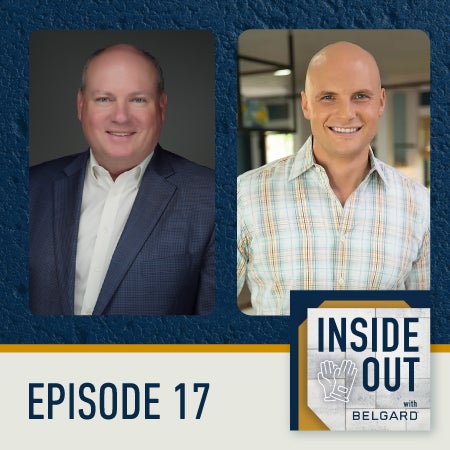
In Episode #17, Joe Raboine and his guest co-host Tim Ortman, President of Oldcastle APG, are joined by Chip Wade, an Atlanta-based contractor, master carpenter and HGTV host. The group discusses current and past projects and what they’re seeing in the industry, along with insights and tips for other contractors in the field. For more information, visit Belgard.com/InsideOut.
Products Mentioned: Elements (Blue Diamond, Pizza Oven, Grills, etc), Linear Fire Pit, Pinhoti Peak Project, Artforms, Diamond Pro Wall, Mixed Materials & MoistureShield Decking, RDI Railing System
Joe Raboine
Welcome back to Inside Out with Belgard, a podcast made for professionals by professionals who are passionate about outdoor living. I’m your host, Joe Raboine, and we’re thrilled to bring you the latest insights from some of the top experts in the industry.
Welcome to another edition of Inside Out with Belgard. My name is Joe Raboine. I am here today with Mr. Tim Ortman. Great to be here. Thanks for joining. We are actually going to co-host a session with the infamous Chip Wade, who is also in the studio. Chip, how are you doing?
Chip Wade
I’m great, Joe, Tim, thanks for having me. It’s going to be a great time.
Joe Raboine
And for those who don’t know Chip, I’m assuming many of you do, but Chip has been affiliated with many projects with Old Castle and Belgard for we were talking earlier, maybe 15 years, it goes, goes back quite a ways.
Chip Wade
It really does. I mean, starting in the days of HGTV shows and that grew into even bigger media projects. I’ve had such great experience with Belgard over the years, but again, I was impressed 15 years ago. So now, I mean. It’s really getting off the charts.
And so, I mean, we have a long and storied history together, which, I can’t wait to kind of reminisce on.
Tim Ortman
I think it just shows you how much the industry has really changed and continues to grow over time to go back and you were showing pictures just earlier of some of your early designs and things you worked on to where it is now.
Like we’ve grown, the industry has grown what outdoor living, well, 20 years ago. But look what it’s come to now. It’s really, we’re almost designed a home around the outdoor space. So, it’s pretty amazing to be part of that.
Joe Raboine
Absolutely. I was thinking back. I think the first, one of the first projects we did was the Elbow Room project back when you were hosting that series.
And I remember I think it was like a hybrid of a water feature and a brick oven and yeah, that’s probably yeah, 2008 and 2009 somewhere back then.
Chip Wade
Long time ago. Yeah. So, and even on that series Elbow Room, I’m certain anytime we had hardscapes, Belgard made some type of cameo that I’m not even sure that y’all even knew about, but that one was cool because it was a little bit more of kind of a hybrid modular build drop in, which is really great. I mean, the concept of closing that gap between design, build, execution, and ultimately getting it across the finish line to enjoy is a real metric when it comes to real projects and real families.
So that was super cool. I mean, there was a, there’s a pizza oven in there, there’s a linear fire pit, really beautiful and of course the hardscape was there as well.
Joe Raboine
You know, it’s fascinating to me, and you know, you and I have talked about this endlessly. If you go back to that project and look at the evolution over the last 15 years, I think, when did we do Misty Mill, what, five or six years ago?
And we recently just did the Pihoti Peak project, and you look at that compared to what we had done way back. It really does mirror the evolution of outdoor living, right? It used to be, outdoor living used to be, if you go way back, it might’ve been a concrete slab, right? With a picnic table. And today these are these fully blown out spaces that have pools and, you know, kitchens, fireplaces, you know, all of the above literally. And your, your projects have emulated that and kind of followed that trajectory as well.
Chip Wade
For sure. I mean, we build really around outdoor living now, everybody talks about it, but to really do it, you have to start from a design standpoint at the fundamental inception of the design or else it becomes, you know, tacked on a little bit. I mean, it can still be somewhat practical, but from an architectural standpoint, when you separate a project from a great project, the design, just a precursor of thought. Of material selection has to be a part of that conversation.
Now what I think the magic is, the next step is like the, almost the ability to use one product for a lot of different things, because I’m a big replicator of product. When you work with one product, you get really good at it. And then when you can get creative with it without it just looking like a sea of one thing, it becomes more cost effective, the quality of install becomes much better. Which can be better for the end client and more profitable also for the installer.
Tim Ortman
You know, if you think about, we used to get inspiration by a designer doing something and then HGTV and others were probably the originators. But now with social media, whether it’s Pinterest or Instagram or, or video clips, et cetera, real, it’s amazing the growth, you get more inspiration, right? And it’s almost like one ups from a contractor, from a consumer point of view, from a designer. How have you sort of seen that sort of change over time, uh, in terms of a bit, like you say, the, the spaces get more impactful. You know, you get the inspiration from other things that you see.
Chip Wade
You know, well, I mean, even AI now is getting a little bit interesting.
I was a little bit like, “Okay, you know, you can’t replicate creativity,” which there’s still some, a lot of truth to that. Mostly truth, but you can get beautiful inspiration images that are kind of hodgepodge together. The real difference is making something that looks beautiful in a picture, or that’s photoshopped, or that’s, you know, somehow even 3D generated.
To having something that actually lives effortlessly, and that is, I think that’s really the benchmark of the best design.
Joe Raboine
I mean, your passion, your background is actually in engineering. People have asked me this all the time about what I mean, it’s fascinating. Because what do you do, right? I mean, you’re hard to put in a box. You’re a designer. You’re a builder. You’re an engineer. You’re a TV personality. What I think is fascinating for me personally is you are living it. I mean, I’ve been to many job sites. You’re out there. You’re lifting block. You’re moving product. You really getting into the weeds on it, and you have this perspective of what’s happening in the broader building industry, right?
I mean, you work with lots of lots and lots of brands on what’s happening in the inside of the house, too. So when you said. You know, kind of there’s this convergence happening where, you know, it used to be that out there living was really like a footnote or it was an afterthought, and now there’s much more thought in how do you integrate that into a home and how do you do something that’s impactful that you can use every day.
And this really aligns with a lot of what we’re we’re saying and thinking as well. So, um, I just wanted to put that out there. You are a multi dimensional person, which I think is It’s fascinating, right? Because you’re, you’re, you’re not just preaching it. You’re living it. You’re, you’re getting your hands dirty.
Chip Wade
Well, no, I appreciate that. I mean, I’ve been very fortunate. I think I have a lot of people’s dream job. I can claim that I work hard, but a lot of people work hard. I’ve stuck with it for a long time. Like I said, I mean, I started in TV back when I was very young. I was, I went to Georgia Tech, studied mechanical and electrical engineering. But then became a structural engineer, kind of, and then got into media truly by accident. I think that’s the biggest thing that, again, it’s not really so much about differentiation, but I want to be represented when I talk to the folks that I actually care about communicating with.
I’m not a media guy, you know, like that’s not what drives me. That’s not what I sought out to be. I’m a doer. I like to put my hands on things and create things. I just so happen to kind of get involved with TV. I did enjoy it. The cool part about the TV stuff and just media stuff in general is it’s kind of just a faster paced environment.
It takes creativity and allows me to do more in a short period of time with resources that are truthfully a little bit, you know, almost ethereal. You know, it’s like a TV show that we’re shooting these 13 episodes and we’ve got this budget. “Wow us.” You know, that’s super cool to be able to do. And if you have a little bit of creativity, but work ethic to be able to push through and push beyond really what’s required.
I think that that’s really where the longevity of what I’ve been able to do has sustained itself is I don’t just kind of stop with the minimum. I’m always trying to create something new and that’s, I think that’s the engineer in me. I’ve been told that I design a little bit more like an engineer. Which again, I don’t know if that’s a compliment or not.
It’s absolutely going to work, you know.
Tim Ortman
It’s going to be safe and sound.
Chip Wade
That’s right. The insecurity of figuring out how to do it is like my wheelhouse. It’s like, well, how are you going to do that? I don’t know. We’ll figure it out. There’s always a way. So the aesthetics are kind of like, they’re the periphery.
They’re really the icing on the cake to what we do, but creating these core fundamental
spaces, I call it crafting the canvas, then everything else kind of, layers on top of that. But, I also really pride myself in being able to understand the process and the materials of what we’re working with.
But, I also learned so much by working alongside the folks that are really doing this day in and day out, whether it be hardscape contractors, whether it be painters, whether anybody, and just absorbing the, there’s no substitute to being out there with your boots on in the pouring rain and seeing exactly the most efficient way to get something done.
And I just, I guess I’ve kind of been drawn to that more so than be repelled by it, you know, it’s been more of an allure to me. And I think that that served me extremely well in on us on accident, you know, a little bit just cause I kind of liked that, but I’ve learned a whole bunch of stuff and I’m passionate about kind of layering in that creative, maybe some of the folks that I work with would call it annoyance because I’m always trying to, you know, not just do like the baseline.
Joe Raboine
I mean, I witnessed this firsthand. I mean, the Pinhoti project is a perfect example. I mean, you and Clint and that crew. You took a design, which we kind of collaborated on, and then you massaged it and you added some things. I know you, we were talking earlier about adding art forms to the fireplace and using our products in a non traditional way, at least a way that we hadn’t thought about.
Tim Ortman
We never would have gone that, that vertical, that high with that product and to think about how the creativity and now it’s like. It’s almost opened up for us a whole new way of design and thought process on how to use a product.
Joe Raboine
I think that’s where your background really does, it’s like a fresh set of eyes on something, right, where we would have a very specific thought process and what we were thinking, and you came along and you switched it up.
I mean, the other thing you used is the landing steps for the cap on the wall. So our Diamond Pro Cap normally is four inches high, but it looks amazing. It’s amazing.
Chip Wade
I mean, amazing is the way everybody says it, it is amazing. Like that is my new standard of like, that’s what it should, it really is the essence of like a castle block.
It feels substantial and heavy. It’s basically a step tread, I think is what y’all designed it for. And this is, I think this is the core of what differentiates this category from a lot of the other stuff that I work with is when I design an interior space, I can design it out all the way until I would say like the 90, 95 percent level.
And then you do the finishing touches. It’s very controllable. Exterior design is, I believe, harder. It’s harder because it’s heavy. There’s other ramifications that come in. You get in with utilities and earth and topography. So what I do when I design an outdoor space is I leave room for that final finesse. But it’s not five or ten percent. It’s like 40 percent so you have good sound fundamental layout, but the beauty of what you guys have it’s like adult building blocks It’s like I get the massing of quantity of what I know I need to work with and then you can literally massage it into perfection, but that happens on site and this is where you know talking with installers and having a trusted pairing between inspiration and execution, I think, is even more important in the exterior and landscape, hardscape, you know, flat work, retaining wall space.
It’s not just who’s the guy that’s going to give you the cheapest square footage price. It is imperative that I have that type of partnership with these guys to be able to get the elevated level of results and the creativity that just doesn’t look the exact same as everything that you see.
Tim Ortman
Well, you talked earlier, too, about getting used to the products and that way you can.
Then you get good at using them. You think of different ways, and the more you’re around it, you know, it’s like finishing a room, right? The room may be great, but it’s the crown molding. It’s the light you hang up. It’s the little details. Well in hardscapes, it’s the same thing. It’s the details that matter.
So what’s the scale of that wall? How do you finish it? And I think that time gets you that and you play around with those elements, and it sort of brings it to life, right? Those details. You were showing me pictures in your early jobs, and you were excited about that. The stuff off to the side, you don’t notice, but it creates the space,
Chip Wade
Typically, you know, like when you’re doing like a tile job or something, industry standard is you have your takeoff and you add, you know, maybe it’s 18 to 25 percent overage just for cutoffs and all that type of stuff.
It’s not completely dissimilar when we’re talking Latin workspaces and exterior stuff. I like to order, honestly, even a little bit more than that, because I know there’s going to be that one thing that ends up being my favorite thing that I don’t even know about yet. But if it’s not there, it almost, the tendency is that it just never ever happens.
And so having that, so that’s a big tip that I would say, you know, it’s not just like throwing away, you know, monopoly money, you know, to just, but having, especially when it comes to hardscape where you might have an extra 20 or 25%. If you can bump that up to 30%, even, low 30%, 35% more product to have there on site, it just gives you that, that freedom to make it great when it might’ve just been pretty good.
Joe Raboine
I love that. That’s a great tip. And you think about, you know, some of the best projects were, you know, kind of an adaptation off an original design, right? When you get into the heart of it, you start tweaking and that’s really where the creativity comes in, right? It’s even from your perspective, having that engineering mindset, right?
I saw all the early renditions of, of what Pinhoti was going to become. And I mean, it’s evolved and that you heavily engineered that out of the gate, right? But even despite that, when you look at the final product, it’s like you said, maybe 30, 40 percent different.
Chip Wade
Oh, of course. But that’s okay. And that shouldn’t be a stressor point. It should be an expectation of your workflow. And when it becomes an expectation earlier on, it just, it doesn’t create an extra bind in your process, especially when the group that you’re working with also embraces that.
Tim Ortman
So you take something from functional, you know it’s going to work, to something different. But I think that one upmanship is pretty exciting, right? That’s the thing, the creativity, that you give a contractor, on site, their ability to do something a little bit different, whether it’s quilting of products or walls or scale or natural elements mixed with, you know, hardscapes that all that sort of creates and it makes it blend a little bit better with nature and the surroundings.
Chip Wade
Well, another thing is I found that in clients, I mean, and a lot of creative installers and trades folks. I mean, there’s a piece of this, but really the end result is who we’re creating these spaces for. I found that that little bit of differentiation and ownership is ultimately what we’re all after.
We just don’t necessarily know how to articulate that at the beginning of the process. So that extra stuff isn’t just really going above and beyond. It’s really getting us to the benchmark of what we’re actually after.
Joe Raboine
What they’re hoping for.
Chip Wade
That’s exactly right. And so I’ve never once in my career said, you know what, wow, that was just an overwhelming waste of effort. It didn’t happen because it’s always proven to be that and it might not even be the thing that I was about at the beginning, but we just stuck with it and pushed a little bit more there. And we’re like, wow, that that’s what made it right there.
Joe Raboine
That’s a great segue to something I was going to ask you. When you think about our audience, most of whom are contractors and are always looking for ways to differentiate. I mean, you work on some incredible projects and I know that didn’t just happen overnight. I mean, that’s been an evolution of a vision that you’ve had and a passion.
What, when you sit down with a client and they are asking you that, what are some tips that you could give our contractors about how you would approach that conversation? We talk a lot about live well outside and this idea that these spaces should be an everyday extension of someone’s life, right? That they should be thinking about how to use that. I mean, what would your process look like? Knowing that there’s still some of that fluidity in the process itself.
Chip Wade
You know, I think the first is knowing your lane. You know, there’s installers that do design and there’s installers that don’t. I think being really clear about that, just industry wide is a good thing to just know what you’re good at.
Just because I’m an architect doesn’t mean I’m a great builder. Just because I’m a handyman doesn’t mean I can design out your new kitchen, you know, but we all as humans like to, I think swell a little outside of our core competency. So even like for whether you’re an installer or your design, being fluid and not too prideful about where, what you have to own in the situation.
Like, yeah, I can design out of space, but I love to collaborate. I think some of it comes down to just being a little bit comfortable in your own skin, you know, to say, “Hey, we can do that, but I can fill in the gaps. I don’t necessarily have to be holding the torch.” So I think that’s the first healthy way for any installer or design, build, outfit, whatever kind of category you fall into.
Joe Raboine
It’s self-awareness, right?
Chip Wade
In my experience, that ends up paying from a trust standpoint so much. You’re going to be found out one way or the other and if you’re looking to grow a business, you don’t want to be found out after you were proven wrong and the homeowners paid money.
Tim Ortman
And you get there over time, too, right? You’ll get that creativity or know your lane of how you can advance and where you can get to.
Chip Wade
But that’s also like you know one of the big, I would say one of the biggest lessons I learned in the TV realm, is working those extra non gratifying hours, what nobody ever saw on TV, you know, getting there at 5 AM, being the last one to leave at two in the morning, calling in my dad or my sister to come help me lay tile at two in the morning.
And then they didn’t even show it in the episode type of thing, you know, like that type of thing for years and years and years and years doing that. That is the stuff that grows you into something that is, that’s going to create a business for you. That will ultimately end up leading to you making a lot of money. But that stuff kind of gets baked into the initial conversation and the initial kind of rollout of what you’re, people can just tell.
Joe Raboine
You said earlier, I think you can’t fake that, right? You either, you have to have that depth. You can’t just walk in thinking you’re gonna own it all from the beginning. You have to pay your dues to some respect.
Chip Wade
You can fake it. You can fake it through to a certain degree, but you’re not going to grow a business. You’re not going to be doing the same thing five, seven, 10 years later and going from a two X business over, you know, nine months to really growing something where business is coming your way and clients are happy and everybody’s giving you good reviews, which again, like as we get older, that’s where we want to be, and that’s the benchmark, which it’s good for everybody, but it’s also good for you, you know, as an installer to, to do that. And I think some of the amazing, I’ve worked with great installers. I’ve worked with mediocre installers. I’ve worked with a couple of ones that weren’t really anything, which we’ve all experienced, but the great ones have some certain qualities to them.
One of the biggest ones we touched on first and foremost is that humility is a big, big deal. Humility paired with hard work is the unstoppable combo when it comes to any tradesman or outfit, but then just being willing to expand, but doing it where nobody necessarily loses. I would say predominantly most individuals underestimate the cost of a project, especially an exterior project.
And I think that hardscape installers, these folks, it’s not about being the cheapest. That’s not really in the conversation. I would pay so much more to work with the guys that I’m working with, only because the cost is going to be there one way or the other. You just don’t realize it yet. It’s whether it’s here or whether it’s next year or five years from now.
Joe Raboine
Pay now, or pay later.
Chip Wade
That is right. And that’s just more of a perspective of thinking a little bit beyond the core circle. So thinking about that, not necessarily being the cheapest, but getting it done correctly. Absolutely correctly, the first time, that is why I recommend the folks I recommend is because I can guarantee that says, you know what, I don’t even know how much he’s going to charge, but I can guarantee you he’s going to do it correctly.
And if something’s not right, he’s going to be back and he’s going to fix it. And you’re not going to get charged to fix it if it’s wrong, which that’s, there’s an unspeakable value there.
Tim Ortman
When we talk about, you know, you talked about creativity and knowing your lane. We’ve sort of seen hardscapes in the outdoor living spaces evolve, whether it’s mixed materials, right?
Now you’ve got, you could have decking, MoistureShield decking. You could have natural elements mixed in with hardscapes. I think in the old days, the world was one, you know, just pavers everywhere. Whatever, concrete, you know, there’s, and now it’s a really mixed medium. How have you seen that sort of change and what’s your perspective from a contractor on abilities and needs to think around using different elements together?
Chip Wade
We ask anybody, whether they know design or whether they just know that they like a picture and don’t know why, there’s the balance that’s necessary. We can’t pave the world, you know, and have everything so hard and cold, even though the metrics of maintenance and ease and overall cost platform, you know, really start to… I like to put as much hardscape as I can, I’ll put it that way. Because it’s really for me, my perspective is how do I balance the hardscape, because I want it there. It’s ultimately in my best interest to have that be a core fundamental, but where can we soften it? Which that’s a simplified concept that I think is easier to grasp.
But it’s like, where do you start in the inside? Flooring is a huge thing, even on the interior of the house. Do I start with the paint color? No, I don’t. You know, but I use that as a leverage piece to be able to balance a lot of the expanse of any material. It’s just anything that you have that is a dominant presence in a space.
And for an exterior, where humans want to live, interact, and having their homes a hardscape and vertical hard surface is just. There’s a crispness to that and I think a lot of people don’t, they just almost think of, um, you know, retaining walls and those types of things like a necessary evil to pick up grade and to be like, Oh, how, why do I have to have a retaining wall?
Like I will put retaining walls in as architectural features as much as, you know, just needing to pick up the grade. And again, that’s where that little bit of extra material comes in and you’re like, Oh yeah, like I don’t even didn’t even realize that. I mean, it’s the predominant cost of what I’m doing.
I don’t even see, you know, but like we’re bringing in the 18 inch wall, that comes across here, and that’s the goal, but that wasn’t necessarily even a functional element to pick up.
Joe Raboine
I’m thinking of while you’re speaking about the Pinhoti project. The landing step that went around the Diamond Pro Wall, and I mean, that didn’t look like a retaining wall that looked like a built in bench, right? That just happened to be outside that outdoor living space. That was a great example of creating really an architectural detail out of something that, yes, it’s utilitarian, but you can make it much more than that.
Chip Wade
So, thinking about that, I think that it’s something that’s really relevant. Like Joe you graced us with your presence at a gathering we had at that Pinhoti project that, by the way, it’s up in the North Georgia mountains. It’s on the top of a mountain. There’s a lot of grade there.
Now this house, it’s about 4, 500 square feet but we designed it to sleep 18 people, right? And at that party, we had 160 people. Imagine having 160 people at your house in your neighborhood. That’s probably not significantly different square footage wise as what we did there.
But the way in which we designed it makes it feel comfortable when it’s maybe just you and your wife there. But then you can have 160 people there comfortably and they were all outside. They like weren’t even hardly inside and it’s because of those types of elements, right? Cascaded through the hardscape that feels natural and scales with you and I think that that’s a magic right there. There’s a magic with interior design that does that that makes it you know we’re not like a long conference table with two people where you kind of feel like, you know This is a little weird
Joe Raboine
When you said that number, I was shocked. I actually thought it was half that number of people. I think just because your point the way that they were spread out and you know the way that you created that home. Like you can’t really tell where the inside or the outside of that house begins because you have that breezeway and those folding glass walls.
You can basically open them up. You walk and you realize that, “Hey, I’m standing in the kitchen, I could walk out here, I’m in the patio,” and it’s all the same grade, right? There’s no threshold difference. I mean, it’s a great example of how you can utilize building design and integrate that with outdoor living, which I think still isn’t being done to the full extent of what it can be but when it’s done well and people experience it. I mean, I would walk through and I’d go, “Why would we not design every house like this?”
Chip Wade
Really what I think happens is that structures get designed and then the hardscape becomes the secondary, “Okay, now what are we going to do for the hardscape?”
Guess what? It’s too late to make that happen, like a zero entry flush threshold happen on a courtyard when you’ve already built everything. Actually one of the biggest challenges in the architectural piece moving forward was I was so absolutely adamant about having a no step threshold coming from the inside, but that’s kind of it’s almost like people wouldn’t even notice it, but they’re like, “This just feels great, like what? Why is this cool? Is it the view?” But there’s just it’s those things that you can’t put your finger on, but that’s what drives me.
Tim Ortman
You have to design that at the beginning again. Outdoor living has always been an afterthought and now you’re seeing where it’s actually you’re thinking about it beforehand because that’s not done the last two weeks on the job that’s done the first month on the job.
Chip Wade
We couldn’t have made that outdoor courtyard at Pinhoti Peak be what it was if it if I didn’t start there and design the house out, I mean, and again, not everybody has the benefit of designing something from the ground up, but if you’re doing a large scale remodel, If you know, that’s like, say, you know, you’re doing like some of the biggest things are, you know, people call me up, we’d end up doing a kitchen, living room, kind of collaboration with some type of extension to an outdoor living space.
It’s all of these folks that are like, “You know what, we’ve lived, we’ve had houses, we know what we want now. What can we do with this hundred thousand or 200 or 250,000 budget?” So, I mean, it’s not nothing, but the, the challenge becomes if you don’t really drive that outdoor living place first it ends up being the the thing that you’re like, “Okay, wow, this seems really expensive for what I got,” rather than It’s like, “Whoa, this is what I’d always dreamed of.”
Tim Ortman
The integration of it versus an add on.
Chip Wade
That’s right.
Tim Ortman
And you want to make it feel integrated.
Joe Raboine
I think you touched on this earlier. I mean, you think about how to do that. I mean, there, we believe there is absolutely an incredible opportunity for contractors to go after that full piece, and it may not be in a half million dollar job. It could be on a 30, 000 job or 50 or whatever, right?
But when you think about the acquisitions of MoistureShield, for instance, where you take an existing home and somebody wants that very smooth transition, they can create that zero threshold with decking and then transition out into hardscape. I know what the Misty Mill project, you guys, that’s exactly what you did.
They’re looking out, coming out there and coming down to the lake. So I think, you know, for a lot of our contractors, and again, we go back to that 15 years ago, right? Who Belgard was, who OldCastle was, and what we’ve evolved to. I mean hardscape was it right? We didn’t talk about that.
We talk about any of that stuff, but the reality is most of the I would say the best projects out there. Almost every project today has some mix of materials. And if you have that skill set in our thinking that way you can create with any home that type of transition, right? That’s right. If you can start from scratch, it’s even better, right to create it. Absolutely from the get-go.
For those who are listening out there, there’s no reason today utilizing things like the folding glass walls or even even just using French doors right and doing it in a way where it doesn’t have to get crazy, it’s just thinking more thoroughly about how can I make a better physical and visual connection with the outside and encourage people to get out there?
Tim Ortman
Well, even some of the railings, another one, right? We’re discovering the RDI railing and our railing program that totally changes the look of the room. You may have an old deck and a look on it. We’ll take that down. Do you want it more modern looking? You want glass? Do you want? You know, about the service.
What do you want that to look like? You can go from a traditional, so even things like that are very detailed changes, but they really change the feel of the space.
Chip Wade
You know, one thing that I think for an installer or anybody that’s doing design or specification out there, one thing that I’ve been very, very successful with that I love doing is I start out every relationship with an initial consultation.
So in order for me to bring actually a value to somebody, I think it takes a certain amount of time and I put like a two to three hour window, which is kind of a lot of time, and I charge for it, but anything less than that ends up kind of being dust in the wind. I feel like, and it’s not really a service to the client, but what I do oftentimes is I bring in other folks with me to that consultation.
And I think that that there’s some magic to that. So like if you’re a hardscape contractor and somebody’s just calling you in for a patio. Possibly think even outside your own realm, because casting an inspirational vision to a client is bigger than just executing even what they’re asking for.
It’s not necessarily trying to upsell them all the time, but for me, I will bring in one of my architects along with me that I love to collaborate with. I mean, certainly could I do it by myself? Sure. I’ve done it thousands of times, but then I might even bring in one of my hardscape contractors and we all are there together and kind of casting this larger scale vision together where mixed materials, but it’s that design kind of magic that can happen early on in the process had amazing success with that.
But it comes from almost a place of humility, which is where we started from before, where it’s like. You know, and it’s not even throwing somebody a bone, you know, it’s really bringing a strong presence and spectrum of knowledge to be able to get answers in a consolidated period of time that ultimately leads to more pointed results, which is what even your client is really after.
At the end of the day, they want to know what it’s going to be, what it can be, be excited about it and generally know what it’s going to cost early on in the process so we can progress.
Tim Ortman
It’s a complete, it’s a little bit where we got in the element side of things, and so it’s thinking through a kitchen and what actually, okay, you can put a grill and no, here’s actually what you can do.
And sort of Blue Diamond, or is there other things? And even the furniture side, we’re looking at to your point, you sort of complete the room. Well, here’s the patio. What do I do with it? Like, it’s not a cool patio until there’s furniture on it. There are pots on it. You know, other elements you were, you know, you’re showing me some factors of details.
It’s those things. It’s, uh, you know, it’s a chandelier in your dining room. It’s a great dining room. Your chandelier sort of makes or breaks it. It’s a bit giving that whole vision of what that outside piece looks like that’s important.
Chip Wade
Well, I mean, another thing that I love about what y’all are coming out with, with some of even the hardscape material is bringing a lot of historically and traditionally exterior materials into the inside of the house.
I mean, I love low maintenance. The older I get, the more I just, I’m like, if this doesn’t, doesn’t matter how good it looks for a year. If it doesn’t look like that for 10, I’m out because you’re going to end up paying for it three times over. And what you guys are doing, even that first one of those projects for HGTV that we did that you talked about that modularized brick oven, that was cool.
But my favorite part was the fact that we brought the hardscape patio actually through a flush threshold into that dining area and into the kitchen. And it’s like, really? Like pavers in your interior kitchen? Like, I don’t know. Until you see it, you’re like, Cool, you know, like this this looks it makes your kitchen look enormous and then it makes your outdoor living area feel more connected and higher level because there’s kind of like this interior exterior combo going on.
Joe Raboine
Yeah, well, I think that’s the perspective I think that fascinates me with you and your team is you’re looking at every facet, right? Most of the time you are designing some part of the interior, at least, maybe all of it, if it’s from, you know, a brand new project. But you’re thinking about the furniture, you’re thinking about how those materials kind of all work together.
I love the example you just gave of, you know, going to a consultation with, you know, maybe one or two other people. Because I think for those contractors who are aspiring to expand into Outdoor Living and they’re like, well, I’m just a hardscape guy or I’m just a deck guy or whatever that may be, there are people out there who definitely will collaborate with you. And, you know, I think to your point, it’s just getting that sense of humility to go ask that, right? Like, we’re not, we’re not all great at everything. You’re lying to yourself if you are right? So I think finding those partners and then, you know, selecting those right projects, I think that cross pollination of creativity is amazing. I know we’ve experienced that on many projects together, so I thought that was one of the cool things always when I first met you that you were willing to collaborate that way. I mean it says a lot about who you are and I think that that’s a great piece of advice for those who kind of are aspiring to get to that.
Chip Wade
Well yeah, I mean no matter how good you are or think you are, there’s somebody that can help make you better. There’s been so many projects that I’ve been on even like with one of my hardscape contractors that I love, with Clint. You know, he’s a diehard Georgia Bulldog. I’ll show up in my Georgia Tech shirt and he’s got his Bulldog shirt on.
You know, the guys that I’m talking to hates Georgia Tech, but he loved Clint. I was like, well, he might not even like me, but, you know, but I like this guy, you know, so it kind of kept you in the game a little bit, you know?
Joe Raboine
What other piece of advice could you give contractors in terms, I mean, you think back, I guess a selfish plug for Oldcastle. As you know, we’ve been acquiring all kinds of companies. We’ve got fencing, decking, railing, pool finishes, we’ve got lots of products that we’re selling in addition to that, like some of the accessories, you know, the grills, you know, the fire pits, all those types of features. How important is it for you as a builder, a designer, to really find partners in the supplier side of it?
Our hope is that we bring value to you by bringing an ecosystem of product. I guess, what are your thoughts about that?
Chip Wade
If you are a small or medium sized outfit, having to hire or orchestrate design and rendering and inspiration services in house is a big deal until you’re doing two, 3 million a year, it becomes like an overhead scenario where that type of metric just starts to kind of be a weighed down thing -and you’re delivering kind of mediocre results.
What I love about what Belgard does is y’all have so much available that I think most people don’t even realize exists. So I think for a hardscape contractor to be able to pull in a lot of what Belgard’s honestly already funded, created and works from a design and inspiration rendering standpoint.
It just makes you look good as an installer or a designer without having to do a whole heck of a lot of that legwork. So I think incorporating a lot of that into your actual sales workflow, where it becomes an asset rather than just like a, “Are they trying to compete with me? Or like, what is this? I don’t know how to use it.”
If you do that effectively, I actually combine all kinds of different resources from all kinds of different brands into my own brand standard kind of inspiration, visualization package that is, I feel like a necessary, final product to win business. So whether, especially if you’re, even if you’re not a design build outfit, there might be somebody that just still wants you to kind of do that.
I definitely recommend that you check out what brands offer, dig deep on the website, it’s not hard to find on Belgard’s website. You guys have great visualization tools to be able to do that and provide lots of services on that design side, to be able to make even a small outfit look and perform professionally, which is going to end up being in your best benefit.
Joe Raboine
Yeah, no, we appreciate that. I know when we talk about Belgard Rooms, for instance, the whole idea behind that was to provide these tools, right? It’s one thing to make a great product and we believe our product is the best and we love every aspect of talking about product. But we know at the end of the day that the client is buying that space, right?
And so, whatever we can do to help make that easier and inspire people up front and provide all the assets and everything needed. That was the idea behind rooms, and I’m glad you see the value in that.
Tim Ortman
It’s really we want to connect with the consumer throughout their journey, whether it’s a few pavers underneath the trash cans or a path around the house, to your first backyard, your second backyard, to a multimillion dollar redo. We want that journey.
And so exactly the whole idea of rooms and design studios, it’s there to help. You go from a small space, a 10, 000 job, partnering with those contractors, making it easy. They get up to speed. We understand the product, they get used to it and by getting comfortable with our products and the more you work with them, the better, then you’re feel better about, okay, doing a little bit bigger project in a multi tiered and levels.
And so it sort of helps us be part of that journey throughout, and really be integral with that contractor. So it’s good to see those tools being used.
Chip Wade
We’re also, I mean, everything is visual. We have to have visualization, that’s the language that we have to speak to clients because regardless of what we say with our words, most of the time our clients words aren’t 100 percent accurate.
It’s not their fault, it’s just not what they do every day. So, it’s our job as the professionals to decipher that and the most universal language. is the visual language, and so the more of your process that can be visual, you’re just taking out the need for the Rosetta Stone of design.
Joe Raboine
People expect that today.
And I think that’s where we feel we can help with things like rooms, right? Because, you know, that back and forth can be extremely frustrating for everybody involved. And when you start with at least some inspirational templates, you can get to that final design in a lot faster manner. And what we’re doing is taking things that are really kind of wrote, right?
If you think about like a fire pit, there might be, I don’t know, 20 variations of a fire pit space. Well, if we, if we make those 20 variations, you can easily tweak them, right? Instead of starting over every single time, you’ve got this kind of foundational building block of assets to work off of.
And that’s really, that’s really the thought process behind what we’re doing is just not to take away design by any means, it’s a really kind of speed it up and help give you the tools, give you as the contractor designer the tools to make something incredible.
Chip Wade
We have also, I think, are making great strides, as much as anybody I’ve seen, on making modularity still feel custom.
Which that’s kind of like, that’s a hard nut to crack. You know, because usually those are in complete contrast with one another. But what y’all are doing with artforms, fantastic. Because it’s still a solid, legit, heavy, authentic material. I mean, we’re talking you know, heavy, long lasting stone, you know, that we’re able to do interesting things with, and even the ability to do anything from mortar set to that, you know, the bracketry system, or combinations thereof, let a little creativity go a really long way.
And so being able to manipulate, like I said, what we did at the last project, putting art forms, for a grill platform, a whole fireplace cladding that we actually use more of like a heavy duty custom brick tie system for, which wasn’t very hard, to cladding gate columns at the front of the driveway to give that design consistency throughout.
But it was just as easy of an application to do it in all three of those things, even though they were a hundred percent different. Which very few materials a lot for that. I mean, so whether it’s a, you know, a water table detail on your house Like there’s all kinds of different things that you can do with these types of products and y’all are keeping your color palettes intelligently placed in between product categories to allow them to coordinate, which is one of those things that just as a designer or somebody that specifies, honestly, it just makes my life easier because I just know it’s going to match.
Joe Raboine
I love hearing that. I know we’re still going through in some areas a transition from our original product line into this new line. And we’re starting to align more with color and still regional variations of course. But the idea behind that was exactly what you said is that you can look at something and go I need this detail for my coping, I need this for the step and they all work together. They have the same pigments, very similar blends, and Pinhoti was a perfect example of that. I don’t know how many different materials we had there. I think there were seven, maybe? Multiple pavers and all different colors for the most part, all different textures, uh, very similar colors, it all works.
Chip Wade
That’s right. But it didn’t feel overwhelming. My big thing is I don’t like to see one or more than like three materials. Like in like a couple of hundred square foot area, and that’s one thing when you’re like designing to understand like when you just got too much going on and when sometimes just pull back and use the same material in a different variation or even sizing difference, you know, sometimes just using the same exact thing in a different scale.
Tim Ortman
And I think a lot of that’s keeping the contractor mind of simplicity of install. But still allowing some customization look to it. And that’s a hard balance to find.
Chip Wade
That’s what we want. I mean, we still want efficiency. As an installer, you want to be able to know what you’re doing, not have a lot of unknowns and be able to get to work, get it done and feel good about what you did so you’re not going to have to come back and be like, “We did that a weird way, we have no idea if that’s going to stand up.” But still have it look like something you’re proud of. I am so excited when one of the trades on my job sites comes up to me and be like, “Chip, check out this project that we just did last week. Check out this, like the homeowners love, like, it is amazing.”
That is the type of thing, even when you’re selling, I feel like I’ve had amazing success because I actually am proud and excited about the work that I do. More so than, actually even the work itself, I think that there is a kind of, it’s more of like a humanistic thing that’s almost on accident that I’ve fallen into that I’m just so into what I do.
It’s almost a contagious, like, well, I think he really believes in himself at least, you know, maybe we’ll give him a shot, confidence goes a long way.
Joe Raboine
I feel that, man, I struggle sometimes to extract myself out of projects because I just feel, you know, you get so excited about what it’s going to become.
You want to just jump in there and bring it to life. And yeah, I love that. And then that’s really what driven your success, right? I mean, if you have to have that level of passion.
Chip Wade
If you’re going to do anything for any extended period of time or years, you got to, you got to kind of, at least be into it.
Joe Raboine
Right. And that is contagious. If your customer feels that, they’re like, “Wow, this is really, I mean, I’m getting something special here.”
Chip Wade
I think that what it does is I think that there’s an inherent sense that there’s going to be pride in the work, which we want to have that trust that somebody is in tune and engaged with what they’re doing.
Tim Ortman
You know, you said it right. I think your enthusiasm always shows when we do these projects and it’s exciting when you go in the contractors, like, “Hey, look at this in this new feature they did.” I think sort of social media and that sharing of ability to get inspiration and design elements and oh I like the way you did that corner, I like that cap that you did on the wall, I like the way you, you weaved in or did a banding on the paper.” Those are the things that get you excited and make it a craft and not just, your installing.
Okay, that’s good. We need installations, but if you really want to be good at and have a craft and make a living and, and differentiate yourself a little bit, that’s what it allows you to be able to do, which is exciting.
Chip Wade
Yeah. And, and I think this is an industry where if you’re good at what you’re doing, there’s such job security because you have to have a specific set of skills. You have to have a specific set of tools. Like, again, I’ve done it before I was really into this, you know, like you can, you can get a pallet of pavers and you can make a patio.
You can do that, but like if it is something over, you know, 100 square foot, I’m calling in reinforcements. That’s I mean, it’s it’s some work to do. And so that’s but that’s a great thing for installers. It’s a great thing to build businesses around this because it if you’re all in, you’re going to have an advantage.
Joe Raboine
I think the timing for this is great. When you think about, you know, again, offering advice that’s, you know, current for the contractors today, I just came off some Belgard U’s last week and you know, you think a lot of contractors are kind of unsure what’s going to happen in the future and there’s a lot of markets where they’re competing on price and they’re trying to figure out how to differentiate themselves.
And one of the things that I like to talk about is using an example like that. There is definitely a market out there for people, for contractors, for people who are looking for these unique projects. And I would say in most markets, there are absolutely not enough. So if you want to separate yourselves, like just finding whatever that unique angle is aligning with other contractors.
But approaching the project again with the idea and the thought of like what is this consumer actually looking for and how can I give them something that’s really cool and unique while simultaneously obviously being inefficient because You don’t want to just make an art piece, right? For the sake of making an art piece, you want to do something that is scalable and is going to grow and make your business prosper, but I absolutely think that even today, despite what they may be seeing out there currently there still is a huge amount of people that are looking for that experience and simply not enough people that are providing it.
Chip Wade
And if you talk to anybody in any industry, it’s not just cause you want it, you know, you’re not getting that, you know, 500, 000 hardscape with the pool and all this, just cause you’re like, “I could do that, and I want it.” No, it’s because your portfolio has stuff that is in there that credentializes you to do it.
And so how do you get a portfolio if it’s hard to get that work? And no matter what industry you’re in, but specifically in the, wheels on- the- ground, on the dirt, how do you do it? Every project that you do, you do a little something extra, in order to build your portfolio. With the exclusive, maybe the homeowner or the client gets a little bit more for their money, but what you’re doing is you’re building something that it’s hard to sell.
So what do you do? When it’s hard for me to sell something, but I want it, what do you have to do? You just have to make it, you have to make it. But if you do that in a regimented repeatable thing, what you’re going to end up doing is you’re going to build visual assets to credentialism you to be able to sell that monster.
Or that really cool creative thing because people will believe that you actually can do it. And so, I think that that’s a little something that any installer can be doing all the time. That can just be done with extra material or just, and it’s really good faith for your client base. Then you control it rather than, you know, them telling you what they want. Which never ends up working out good for you.
Joe Raboine
Well, good. I know us three, we could probably talk all day, and we have. I’m going to try to wrap it up first. I’m gonna ask you a question first, Tim, when you think about what you do and your role, what is it about your role currently that fulfills you the most?
Tim Ortman
I mean, I think ultimately I’ve been part of OldCastle for 20 years. So if you think of sort of the products and the growth we talked about of the business, I love outside. I love being outside. I appreciate the time I spend outside with family, with friends, with neighbors, the community aspect, biophilic design.
I know you talk a lot about Joe, and you don’t want to be outside unless it’s really hot. You don’t say let’s go inside. I want to be inside all the time. You prefer to be outside. And so I really like the industry. I like where it’s going. I like that. It’s growing. Um I like that. We have a more holistic view.
It’s don’t we don’t want to hardscape the world. We want outdoor living spaces, and we want to. We don’t have products that fit around those spaces spending time really thinking through and working with. Contractors and designers and designers and designers and designers and and partners and consumers and really thinking through what this business could look like?
And what are the pieces that are missing and how do you create that? Space from the green space that you need with it to the hardscapes to natural elements to man-made? How do all those things come together? So for me, that’s what’s fulfilling about my job is I have a passion for the industry. I have a passion for design.
I get excited just like everyone else. I’m fortunate to see thousands and thousands of pictures monthly of our jobs. It’s fun. You’ll never design the ultimate backyard. And to be in a business where you’re doing that, where there’s really no end to it, that creativity is in the hands of designers and contractors. That’s a cool field to be in.
And so that’s what inspires me every day. I just think it’s the coolest thing in the world, what we do, and being part of that business and a great team and partners like you, Chip and others, it’s just, it’s an awesome thing to be part of.
Joe Raboine
You know, that drives me as well. I mean, that whole idea, like we’re creating spaces that help people, right? I mean, that connects them with nature, connects them with their neighbors. I love what you’re doing as well to support the “Live Well Outside” initiatives where, I think we talked about a little bit, we’re doing, recharging stations, even at our own facilities and really trying to embody this idea that, you know, the outdoor living space, it shouldn’t be viewed as just a luxury item. It’s not a nice to have, it’s really a need to have. So, I love hearing that as well. I guess with that, I’ll ask you the same question.
What is it about what you do and you do a lot, a lot of different things, that you find most fulfilling?
Chip Wade
If I had to kind of distill it down, I just like to create, I like to problem solve and I like to create and you know, that manifests itself in different things, physically and design a creation of content, all these types of things. Finding, having a problem, having a challenge, and solving it creatively and getting to do it over and over again.
I think that’s what scratches the itch ultimately. And then like I said, I mean, I think I have a particular knack for the kind of the design and build space and storytelling, but I think I’m, I’m passionate about helping people with decision making in the home category space. Helping people make educated, decisions from the experience that I’ve been afforded.
I mean, I’m lucky because I get to sit with very smart people, very talented people, or work along folks every single day where I get a perspective that’s really a luxury. A lot of people don’t get that perspective. And honestly, it’s not hard for me to share. And I’m excited about sharing it because I feel like a couple of trusted words can go a really long way in helping people in their journey of whatever that is.
So maybe I’m helping people design something. Maybe it’s just a recommendation between this, and this, and you know what, I’ve used both of them and five more things. And it’s actually of those two, I’d probably say this, but have you thought about this whole thing in a new way? And they’re like, “Oh my gosh.” To me, that’s sweet.
That wasn’t even hard for me. And I just like saved you a lot of money and time. That’s gratifying. And I feel like it’s using the gifts that I have in something that’s joyful because it’s not that hard and I’m good at it, and I think we’re all looking for that. The fact that I get to kind of do that in a space that is exciting for me is definitely what I love.
Tim Ortman
Chip, appreciate really the passion you bring. You know, one of the things we push is we don’t want outdoor living to be an afterthought, right? And we talked a little about that earlier. It has to be part of the initial thought, or you want to just, you know, have a blank canvas in your backyard. I think I told you that’s that’s my favorite way to get a house and have a blank canvas, but it takes excitement and creativity and bringing that passion and energy. It’s obviously apparent in you, and that’s what we want apparent in everyone part of the organization. It’s pretty exciting to be around. So thanks for sort of bringing that energy to the space and shining a spotlight on it.
It’s meaningful and changing for the industry.
Chip Wade
Well, I love it. And I love, obviously, I mean, having brand partners that I trust and make my job easier. It really boils down to that. I mean, you guys are great. You’re great friends on a personal level, but the products stand up to the test of time and ultimately they make me look good and help me grow my business, which I think is a must have in something that is going to propagate and grow.
We all win. We all grow together. So thank y’all for making great stuff and to continue to be seeing what else needs to be, sussed out, experimented on, fabricated, scrapped, and something different made, you know, so thank y’all for that. I’m excited to do more projects and leverage my creativity to see what, what else we can make.
Joe Raboine
Fantastic. No, we appreciate you being a partner of ours and we love the collaboration and we hope this continues for many, many years
Chip Wade
For the next 15, let’s go! Bigger, bigger and better!
Joe Raboine
Well, thank you both for joining. Hopefully, everyone enjoyed this session, I thought it was great.
Thanks again for joining us on Inside Out with Belgard. Make sure to subscribe so you don’t miss an episode, and please leave us a rating and review! Head over to Belgard.com/InsideOut. To find hardscape educational resources, product details, design inspiration and more, visit Belgard.com, and keep up with us on social media at Belgard Outdoor Living on Instagram and Facebook, and Belgard Hardscapes on YouTube. Join us again next time on Inside Out with Belgard.